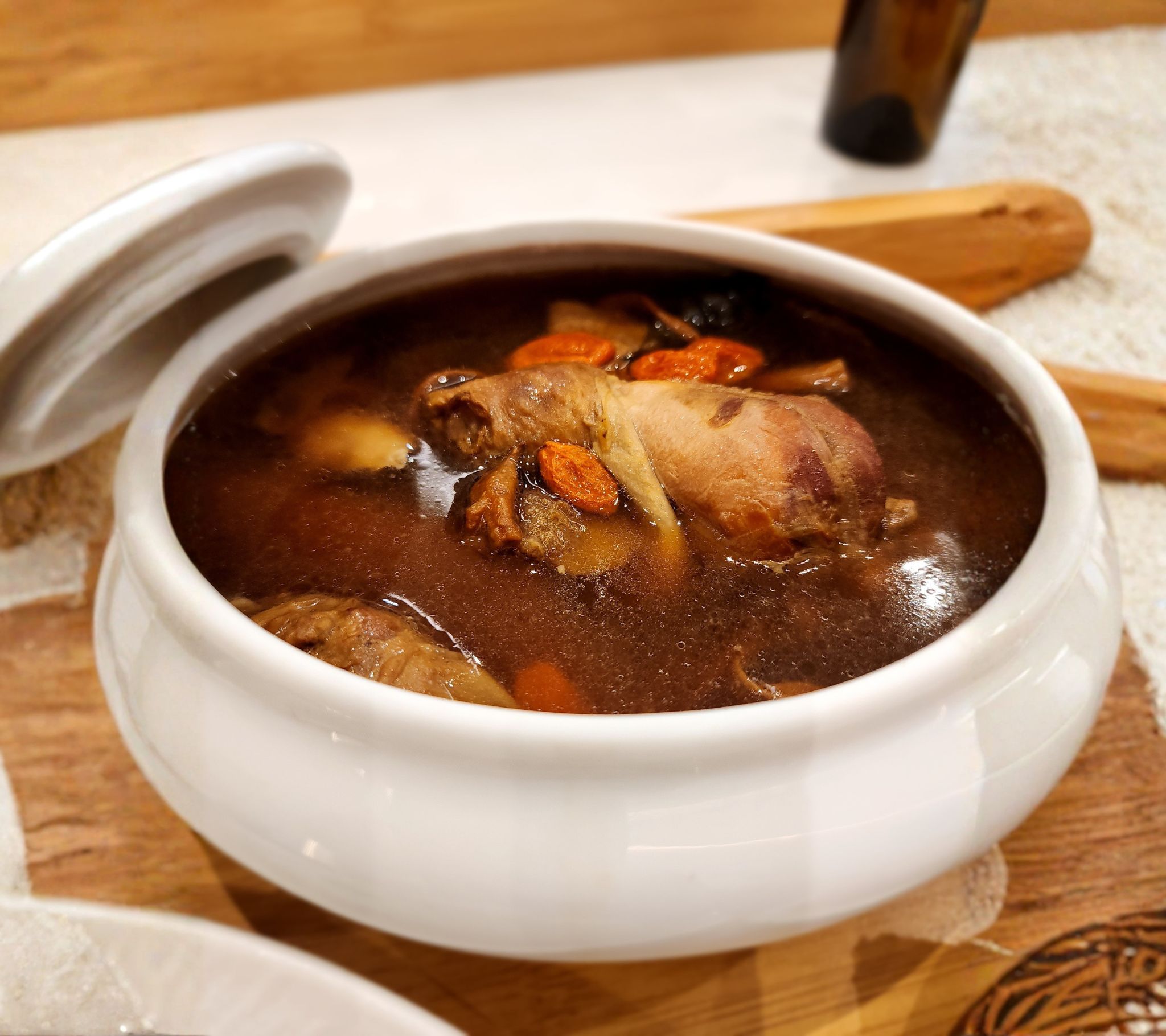
Day 4. The sesame oil chicken arrives, you lift the lid, and the smell hits you like a Friday night. Your mother-in-law nods happily. You wonder if you are still allowed to feed your baby after this. Fair question.
Why rice wine is in the pot at all
In traditional Chinese food therapy, rice wine is "warming" and "moving". The belief is that it helps blood flow, drives out cold, and makes the ginger and sesame oil work harder. Hakka and Hokkien confinement dishes lean on it the most: sesame oil chicken, rice wine chicken soup (酒鸡汤), and the red rice wine lees (红糟) dishes.
It is also simple cooking sense. Wine lifts the smell of the meat, softens the sharp edge of ginger, and gives the soup a deep, sweet finish. Part of why it is there is taste, not only tradition.
How much alcohol is left after cooking?
Less than most people think, and more than others hope. The commonly quoted figures come from US food-science tables. They give a good rough idea of what stays in the pot:
- Added to hot liquid, heat turned off: about 85% stays.
- Flamed: about 75% stays.
- Simmered 15 minutes: about 40%.
- Simmered 30 minutes: about 35%.
- Simmered 1 hour: about 25%.
- Simmered 2 hours: about 10%.
- Simmered 2.5 hours: about 5%.
So a double-boiled chicken soup that sits for 3 hours is very different from a stir-fried sesame oil chicken where the wine goes in for the last 10 minutes. The second one can keep well over half of its alcohol. Home recipes that call for a full bottle of rice wine, with little added water, sit at the strong end.
Also remember that rice wine is not light. Cooking Shaoxing wine is usually around 15 to 20% alcohol, and some tonic wines are stronger.
What this means if you are breastfeeding
Alcohol passes from your blood into your milk, at about the same level. It rises and falls with your blood, so it does not get "trapped" in the milk. Public health advice in many countries is that a rare, small drink is not a disaster, and that heavy or regular drinking is a concern for a young baby.
A bowl of well-simmered wine soup is far from a drink. But if you eat wine-heavy dishes at 2 or 3 meals a day for 28 days, it adds up in a way that one bowl does not. That is the part worth thinking about. It is also why many mums choose a lighter version, or no wine at all, while the baby is tiny and feeding every 2 to 3 hours.
Getting the flavour without the wine
- More ginger. Old ginger, sliced thick and fried in sesame oil until the edges curl, carries most of the warmth you are looking for.
- Simmer longer. If you do keep the wine, add it at the start, not the end, and cook the pot for at least 1 to 2 hours.
- Swap part of it. Use half the wine and top up with water or plain chicken stock.
- Add sweetness. A few red dates, goji berries and a little rock sugar give the rounded finish that wine usually gives.
- Check the lees and "wine sauces". Some rice wine lees and bottled wine sauces still carry real alcohol. Read the label.
Many Muslim and non-drinking families in Malaysia confine without any alcohol at all, and the soups are still rich. Ginger does most of the work.
The honest part: tradition versus evidence
No good study shows that rice wine speeds up recovery after birth. The "warming" idea comes from food therapy, not from clinical trials. On the other side, no evidence says a small cooked amount in a long-simmered soup will harm you. So you are in a grey zone, and both camps can be reasonable.
What helps is knowing which dishes carry more. Soups cooked for hours are light. Quick-cooked dishes with wine added late are heavy. And if your family insists on the strong version, you can say, kindly, "I will have the soup and skip the stir-fry for now."