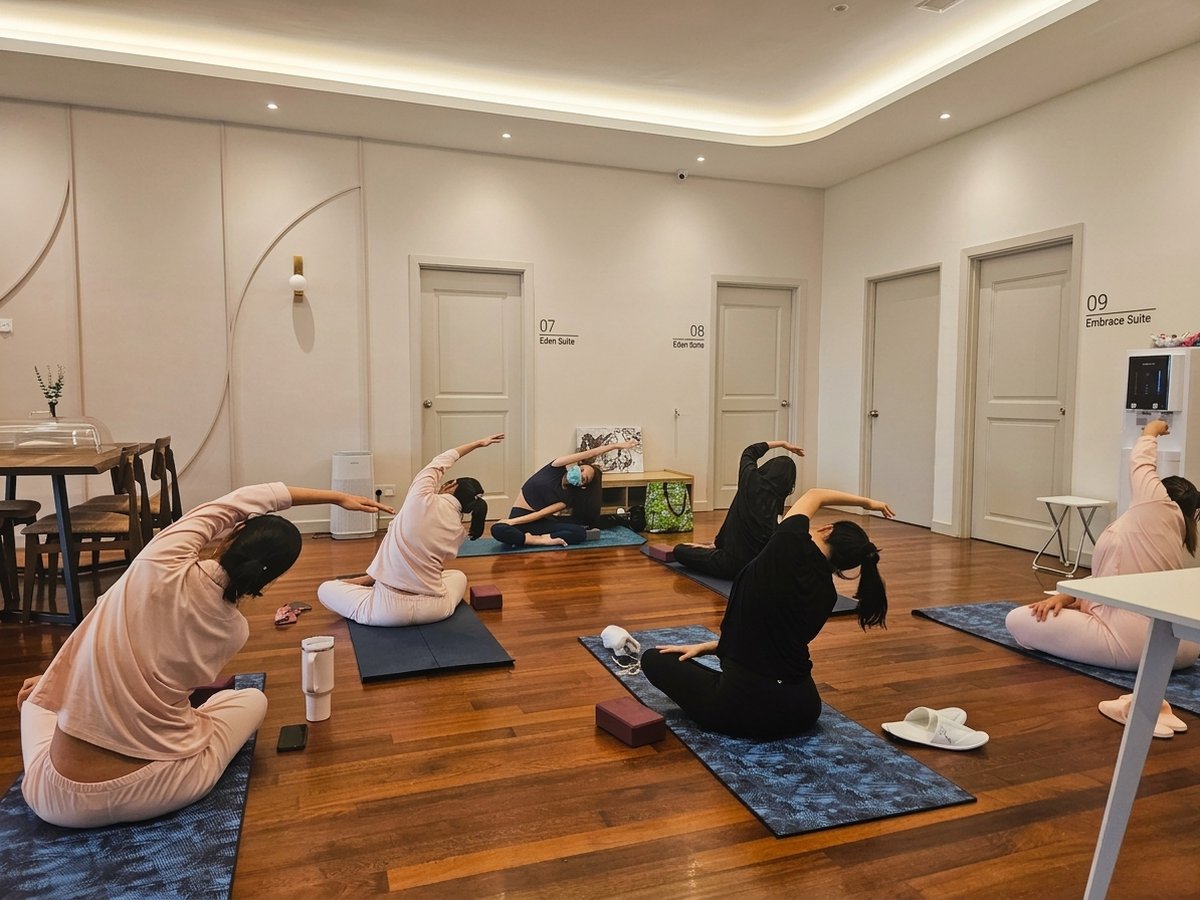
The pelvic floor is a hammock. That is the simplest picture, and it is correct. A sling of muscle stretches from your pubic bone at the front to your tailbone at the back, side to side between the sit bones, holding up everything in your lower belly: bladder, uterus, bowel. You have walked around on it for thirty-odd years and never thanked it once.
Now you are pregnant, and that hammock is being asked to hold up a melon that gains weight every week. Over nine months, that sling lengthens by around 25%. By the time you give birth, it has done more work than your hamstrings have all year. This is the muscle worth getting to know.
What it actually is
The pelvic floor is not one muscle. It is a group, woven in three layers, that together form the floor of your core. They wrap around three openings: the urethra, the vagina, the anus. They close those openings when you cough, sneeze, laugh, lift something heavy, or jump on a trampoline at a kid's birthday party. They open those openings when you wee, when you poo, and when you give birth.
Things they also do, quietly, that nobody told you:
- Keep your spine stable when you lift a toddler
- Help pump blood back up from your lower body
- Co-contract with your deep abdominals to keep your back from hurting
- Sit at the base of every breath you take
When the pelvic floor weakens, you do not feel it until the day you cough and a drop of wee escapes. That day is famous. It is also avoidable.
Why pregnancy is the hardest workout it ever does
Three things happen during pregnancy that beat up the pelvic floor.
Weight. By week 36 your uterus, baby, placenta, and fluid weigh together about 5 to 6 kilograms. That weight sits on the hammock all day. The hammock stretches.
Hormones. Relaxin and progesterone soften your ligaments and connective tissue from week 6 onwards. The sling becomes more elastic. Elastic is good for birth. Not so good for holding things up if you also have not been training it.
Time under tension. A muscle held in a stretched position for nine months will weaken if you do not actively use it. Same reason your hip flexors get tight when you sit at a desk all year. The body adapts to what you ask of it.
Some women finish pregnancy with a pelvic floor that has lost meaningful baseline strength, before they even get to the birth itself. The good news: the muscle responds quickly to training. Two to three weeks of consistent practice and you can usually feel the difference.
How to find the muscle (without the wee-stopping test)
Most pregnancy books tell you to stop your wee mid-flow to find the muscle. Then they tell you not to actually do this regularly. It is confusing. There is a cleaner way.
Sit comfortably, or lie down on your side. Close your eyes. Imagine you are about to pass wind in a quiet meeting. Stop it. That tightening at the back is your pelvic floor.
Now, separately, imagine you are stopping a wee mid-stream. That tightening at the front is the same muscle group.
Do both at once. Lift up and in, like you are picking up a blueberry with the muscle and tucking it into your belly. That is the real squeeze.
If your bum cheeks are clenching, your inner thighs are tightening, or your belly is doming outward, you are using accessory muscles. Soften them. The pelvic floor works on its own.
The 5-minute daily practice
Two short sessions, morning and evening, for the rest of pregnancy.
Set A. The hold. Squeeze the muscle as described. Hold it for 5 seconds. Release it fully (this part matters more than the hold). Wait 5 seconds. Repeat 10 times.
Set B. The quick. Squeeze and immediately release. One second up, one second down. Repeat 10 times.
That is one round. Aim for three rounds across the day. Brush your teeth, do one. Sit at a red light, do one. Wait for the kettle, do one. The whole thing is 5 minutes, scattered.
By week 20 you should be able to hold for 10 seconds cleanly. By week 30, you should be able to hold while walking, and breathe through it without your shoulders climbing up to your ears. That last part takes practice. It is also the part that matters most for birth.
What "doing it wrong" looks like
A meaningful share of women do the squeeze wrong on first attempt, even after reading the instructions. Three common errors:
- Holding your breath. If you cannot breathe through it, you are gripping too hard or bracing your abdomen instead. Soften.
- Clenching your bottom or thighs. A giveaway that you are recruiting backup muscles instead of finding the right one.
- Forgetting the release. A pelvic floor that can only squeeze and cannot let go is also a problem. It can make birth harder, not easier. The release is half the exercise.
If you cannot find the muscle after a week of trying, a pelvic floor physiotherapist can teach you in one session. In KL the options are growing (ProRehab, PhysioMobile, Twin Tower Physio, and others). It is one of the most useful 30-minute appointments of your pregnancy, and the people who go usually wish they had gone sooner.
The honest part
If you are already leaking a little when you cough or sneeze in this pregnancy, that is common, not catastrophic, and it usually improves with training. If you feel a bulging or heaviness in the vagina that gets worse by evening, that is a different conversation: see a doctor or a pelvic floor PT, not to panic, but because it is treatable and worth catching early.
If this is your second or third pregnancy, the pelvic floor has been here before. Be kinder to it. Start the daily practice earlier. The recovery margin is narrower the second time around.
Your pelvic floor is a muscle. Muscles respond to training, in both directions. The nine months coming up will ask a lot of yours. You can either ignore it and recover on the back foot, or spend 5 minutes a day for the next 200 days and walk into postpartum with a strong base. The math is in your favour.