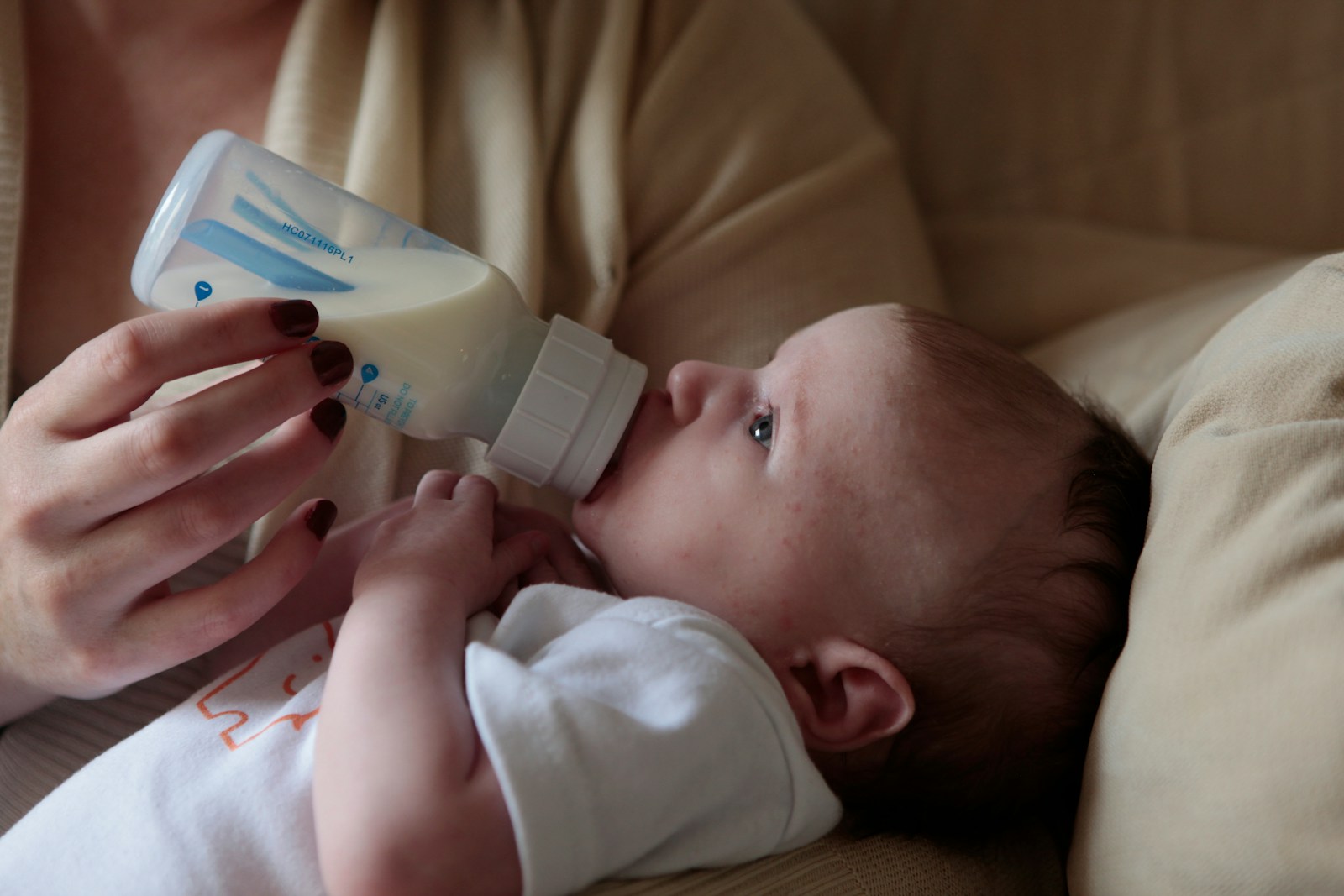
Your milk supply and your calendar had a disagreement, and the calendar won. Maybe it is the return-to-work date circled in red. Maybe it is twins, and someone has to hold a bottle while you feed the other one. Maybe it is 3am and you would like your husband to take one feed so you can sleep for four hours in a row. Whatever got you here, you are now looking at a fridge with a nursing pillow on one side and a tin of formula on the other, wondering if that makes you a bad mum.
It does not. Combi-feeding, mixing breast and bottle in whatever ratio your family actually needs, is one of the most common ways babies in KL get fed. It rarely gets talked about because the conversation online tends to split into two camps shouting past each other. Here is the practical middle.
What combi-feeding actually looks like
There is no single "correct" ratio. In practice it usually falls into one of a few patterns: one bottle a day at the nursery or with the confinement nanny so mum can nap or shower properly, formula for the overnight 10pm to 2am stretch so a partner can take that feed, a 50-50 split when supply genuinely cannot cover every feed, or fully pumped milk topped up with formula for twins or a baby who cannot latch yet. None of these are "less than" exclusive breastfeeding. They are a different shape of the same job: keeping a baby fed and a mother functioning.
The supply math: how not to end up all-formula by accident
Milk supply runs on demand and removal. Skip a feed without removing milk some other way, and your body reads that as a signal to make less next time. One dropped feed a day, replaced by a bottle with no pumping, usually costs very little, often under 10% of supply over a couple of weeks, and many mums do not notice a difference at all. Drop two or three feeds a day cold turkey, though, and supply can fall by half within 7 to 10 days, because the body recalibrates fast once demand drops sharply.
If your goal is a stable combi routine rather than a full wean, pump once at the time of each dropped feed for the first 1 to 2 weeks. This tells your body the demand is still there even though baby is drinking from a bottle. Once your supply has settled into the new rhythm, usually 2 to 3 weeks in, you can often taper the pump session too, dropping it every few days rather than daily, and watch how your body responds before dropping it entirely.
Spacing matters as much as quantity. Dropping one feed a week gives your body time to recalibrate. Dropping one feed a day is what turns "combi-feeding" into "fully formula" faster than most mums intend, sometimes before they have actually decided that is what they wanted.
Bottle plus breast: the logistics
Nipple confusion is real for some babies, particularly in the first few weeks before latch is well established, but it is overstated as a blanket rule. The bigger cause of a baby who suddenly prefers the bottle is flow rate, not the shape of the teat. A bottle delivers milk faster and with less effort than most breasts in the early weeks, so a baby who is offered both may start holding out for the easier option.
Paced bottle feeding largely solves this. Hold baby upright rather than reclined, keep the teat horizontal rather than tipped down, and let baby pause every 20 to 30 seconds the way they would naturally at the breast. This slows the flow, keeps baby working for the milk, and makes the switch between breast and bottle far less jarring for both of you.
If exclusive breastfeeding is still the longer-term goal and you are combi-feeding for a specific short-term reason, most lactation consultants suggest waiting until breastfeeding is well established, usually 3 to 4 weeks, before introducing the first bottle. If there is a medical reason to start sooner, a paediatrician or IBCLC can guide the timing properly. Neither path is wrong, they are answers to different questions.
Formula in the KL heat: the numbers that matter
Rough guide by age: 60 to 90ml per feed in week 1 to 2, roughly 90 to 120ml by 6 to 8 weeks, and 120 to 150ml by 3 to 4 months, spaced across 5 to 10 feeds a day depending on age. As a whole-day check, about 150ml per kilogram of body weight is a reasonable guide, so a 4kg baby is roughly 600ml across the day, split however the feeds fall.
KL humidity and heat make formula safety a real practical concern, not a theoretical one. The WHO guidance is to mix formula powder with water that has been boiled and then cooled to no less than 70 degrees Celsius, which kills bacteria that can be present in the powder itself, then cool the bottle further under running water before testing it on your wrist and feeding. Once made up, use it within 2 hours if it has been sitting at KL room temperature, or refrigerate immediately and use within 24 hours. Anything left in the bottle after a feed, discard, do not save it for later.
The honest part: guilt comes from both directions
Some mums feel judged by an exclusive-breastfeeding culture online that treats a bottle of formula as a moral compromise, something to apologise for in the caption. That pressure is real, and mostly unhelpful. Others feel judged the opposite way, an older relative pushing formula early "so you can rest," treating any breastfeeding struggle as needless suffering nobody should sign up for.
Neither camp is fully right about your family. The honest answer sits somewhere in the middle and looks different for every mum: the version of feeding that lets you and baby both eat, sleep, and actually function through the day is the right one, whether that ends up being 90% breast, an even split, or mostly formula with a breastfeed at bedtime. Fed and calm beats exclusively anything and exhausted.