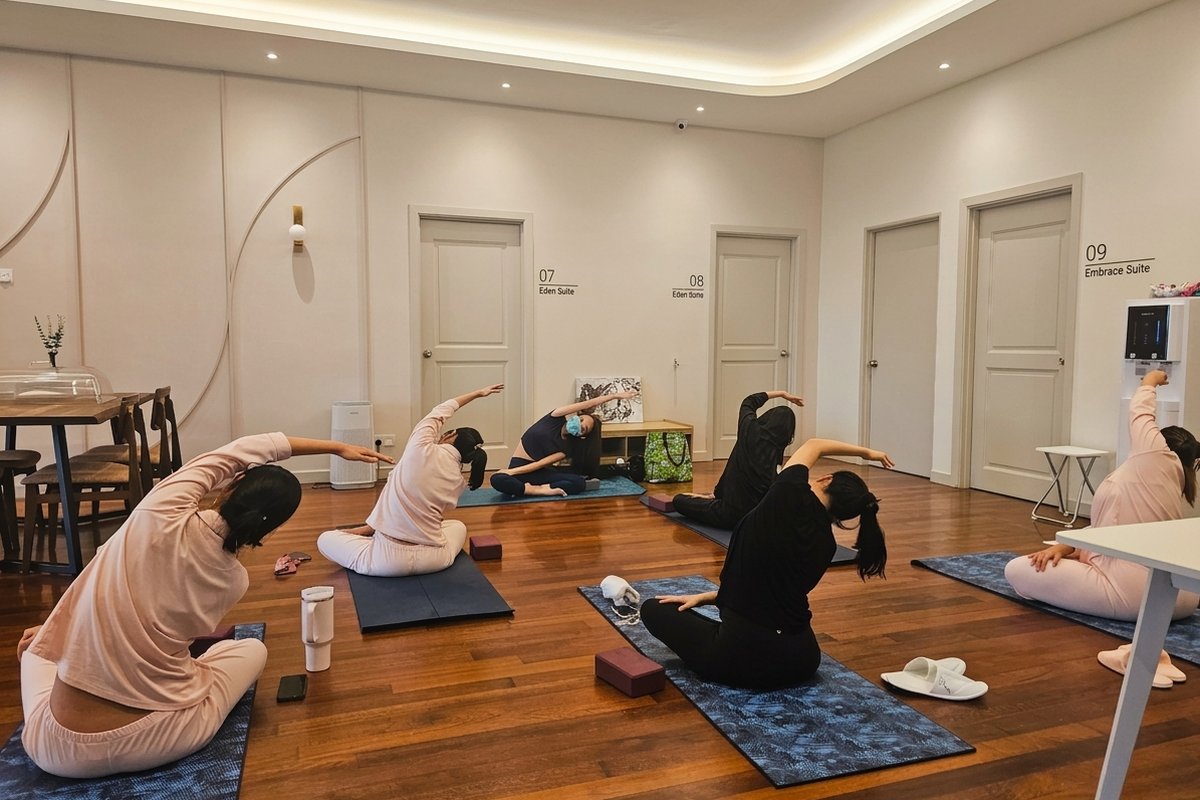
Nobody warns you that your first proper sneeze after birth will feel like a betrayal. You sneeze, you leak, you laugh, you leak again. Welcome to your pelvic floor, which has been quietly holding everything up for 40 weeks and is now, understandably, tired.
This is the 12-week plan we wish every mum got handed on day one, instead of a vague "do your kegels" and a friendly wave out of the ward.
What actually happened down there
Your pelvic floor is a hammock of muscle that runs from your pubic bone to your tailbone. During pregnancy it carried a growing baby, a placenta, extra fluid, and a heavier uterus. During birth, whether vaginal or C-section, it stretched, strained, and in most cases got a bit disorganised.
Even a straightforward C-section counts. The pregnancy itself did the softening, not just the pushing. Which is why "I had a C-section so my pelvic floor is fine" is one of the most common misunderstandings we correct at the centre.
Weeks 1 to 2: rest, breathe, no kegels
The instinct is to start doing something. The right move is the opposite. In the first two weeks:
- Lie down when you feed. Side-lying or reclined, not hunched over. Gravity is not your friend yet.
- Belly breathe, 5 minutes, twice a day. Hand on belly, hand on chest. Breathe in through your nose so only the belly hand rises. Long slow exhale. This is your first pelvic floor exercise, whether it looks like one or not.
- Log-roll to get out of bed. Turn onto your side first, push up with your arms, drop your legs off the edge. No sitting straight up.
- Skip the kegels. Yes, really. Squeezing hard right now teaches the wrong pattern (gripping and holding your breath) which you will spend weeks 4 to 8 trying to un-learn.
If you leak when you cough, that's information, not an emergency. Note it. We come back to it.
Weeks 3 to 6: waking the muscle up gently
Once your bleeding has slowed and you feel less tender (usually around week 3 for vaginal, week 4 to 6 for C-section, but wait for your own body), start "connection work", not strength work.
The right pelvic floor contraction:
- Exhale slowly, like you're fogging up a mirror.
- On that exhale, imagine you're gently lifting a blueberry up and away from your seat.
- On the next inhale, let it go completely. Full release. This half matters more than the lift.
- Repeat 8 to 10 times. Twice a day. That's it.
What it should NOT feel like: holding your breath, tightening your bum cheeks together, or scrunching your face. If you can't talk normally while you do it, you're recruiting the wrong muscles. Restart.
Weeks 6 to 8: after the check-up, add load
Your 6-week postnatal check is the gate. Get cleared first, then progress. Add:
- Longer holds. Lift, hold for 5 seconds while breathing normally, release for 5. Ten reps, twice a day.
- Quick pulses. Lift, release, lift, release, ten times in a row. This is the muscle that catches sneezes.
- Bridges. Lying on your back, knees bent, exhale and lift your hips, gentle pelvic floor lift as you go up. Ten reps.
- Walking. Twenty to thirty minutes a day, upright posture, arms swinging. Best pelvic floor exercise nobody calls one.
Weeks 8 to 12: back to your life, on purpose
By now you can start layering pelvic floor work into daily movement instead of doing it as a separate homework assignment. Squats with a lift on the way up. Bending to pick up baby with an exhale-lift, not a breath-hold. Carrying the car seat with a gentle brace instead of a locked breath.
This is also when running, jumping, or heavy weights becomes a real question. The honest answer: most physios don't clear high-impact work until at least week 12, and often 16, and only after they've assessed you individually. Don't jump back into your pre-baby HIIT class at week 8 because Instagram says you should.
The honest part: kegels alone don't fix everything
You can do perfect kegels for three months and still leak. You can also do zero kegels and be fine at week 10. Pelvic floors are genuinely individual. The most common reasons a "good plan" doesn't work: a hidden diastasis recti pulling your core out of alignment, a tight (not weak) pelvic floor that needs releasing before it can strengthen, or a scar (perineal or C-section) that's tethered and pulling on the tissue around it.
None of these are things you diagnose from a blog post. All of them are things a pelvic floor physio finds in one 45-minute session. In KL, a session runs roughly RM 200 to RM 350 at private clinics, and one to three sessions is often all a straightforward case needs. Cheaper than three more months of Poise pads.
See a pelvic floor physio now (not wait-and-see) if: you feel a heavy dragging or "something falling out" sensation, you can see or feel a bulge at the vaginal opening, leaking is getting worse instead of better after week 6, or sex is painful past week 8. These are signs, not verdicts, but they earn you an early appointment.
This is information, not medical advice. Your doctor and pelvic floor physio know your specific case.