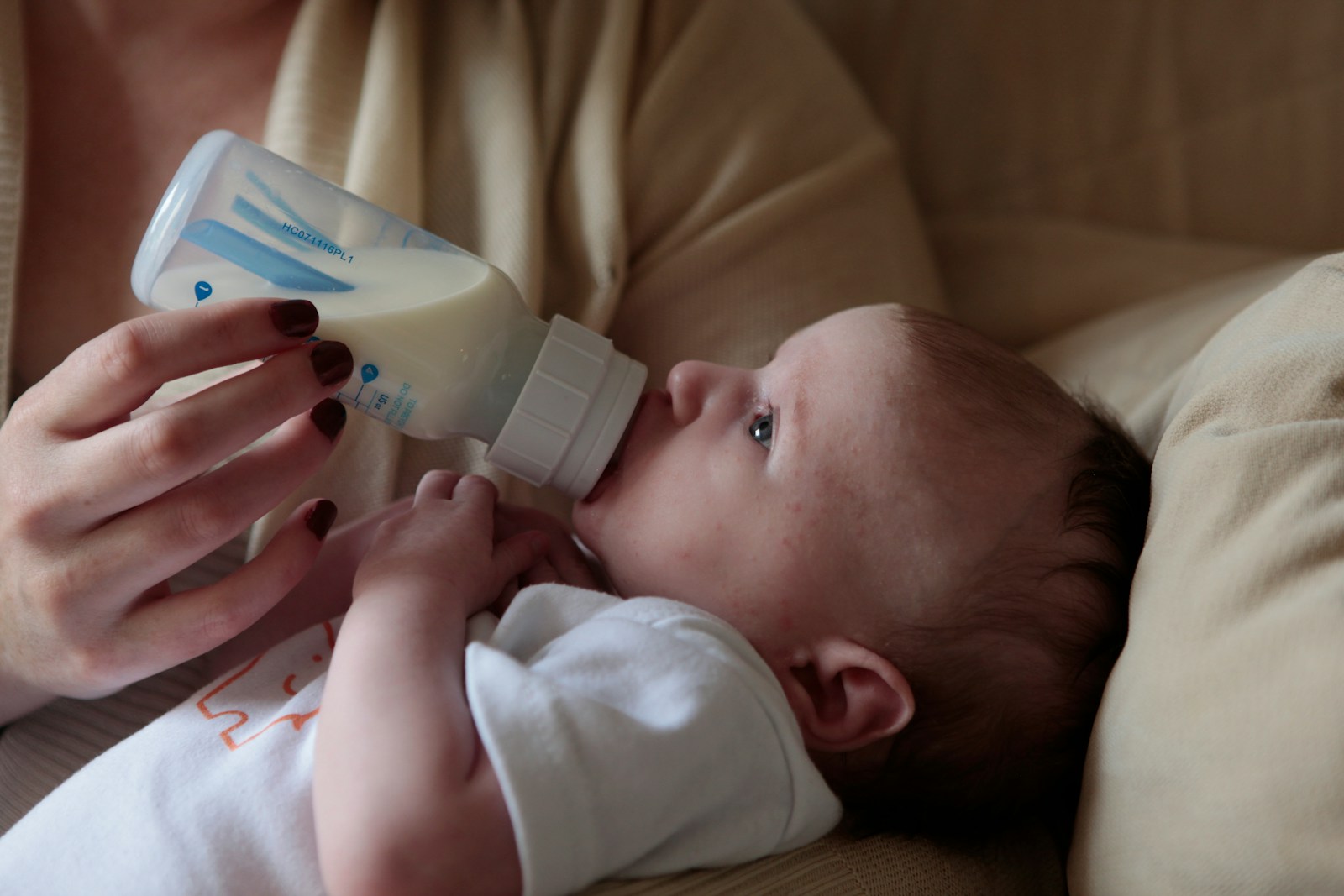
Day 64. You bought the bottle the WhatsApp group swore by. You warmed your pumped milk to 37 degrees exactly. You sat in the right chair, said the right soft things, and your baby looked at the teat like you had personally betrayed her. Then she screamed.
Welcome to bottle refusal. It is one of the loudest phases in early feeding, and almost nobody warns you it is coming, especially if your first two months on the breast went smoothly. The maternity leave clock is ticking. The pumped milk is piling up in the freezer. And the baby will not drink it.
Good news first: this is almost always fixable, and the fix is almost never a new bottle.
What "bottle refusal" actually looks like
It is a whole spectrum, not one behaviour. Any of these counts:
- Clamps her mouth shut the second the teat touches her lips.
- Takes 5ml, makes eye contact, then screams as if you tricked her.
- Pushes the teat out with her tongue every time you put it in.
- Gags or chokes after the first swallow, then refuses to try again.
- Falls asleep mid-feed within 30 seconds, wakes furious 10 minutes later.
- Will take a bottle from grandma at 3pm but not from you at 9pm.
Most KL mums hit this between week 6 and week 14, right as the 98-day maternity leave countdown starts looking real. Your baby is not stubborn or "too attached". She is six weeks old. She does not have a strategy.
Why babies refuse (the real reasons, not the marketing)
Bottle marketing wants you to believe the brand is the answer. It almost never is. The real culprits, ranked by how often we see them:
- Flow rate. Too fast, milk floods her and she quits. Too slow, the bottle feels like more work than the breast. Most refused bottles in week 6 to 12 are using teats one size too fast.
- Mum is the wrong holder. If you smell like breastmilk and you are the source of every feed for 60 days, your baby has zero reason to accept a plastic substitute from your arms.
- Position. Flat on the back, head tilted, teat dangling down: that is how feeding dolls work, not babies. Most refusers do better upright, semi-upright, or side-lying.
- Temperature. A cold teat against a warm tongue is a startle.
- The window. Overtired, overhungry, or "I want to nap not feed" all read as refusal but are really about timing.
- Introduction too late. Babies who get their first bottle at week 10 refuse much more often than babies who got one at week 4. Many lactation consultants now suggest one practice bottle a week from week 4 if you know you are going back to work.
- Teat shape preference. Real but rare. Try the easier fixes first.
The 8 things to try, in order
Start at the top. Cheapest, smallest tweaks first. Most refusers crack on items 1 to 4.
1. Get out of the room
Let someone else offer the bottle. Dad, grandma, sister, your nurse if you are at the centre. You leave the house, or at least the floor. Babies who can smell breastmilk in the next room will hold out for the source.
2. Drop down a teat size
Almost every refuser is on a teat that flows too fast. Go to a slow-flow or newborn-flow, even if your baby is past "newborn" on the box. If milk drips out when you hold the inverted bottle still, that flow is too fast for a 2 month old.
3. Time it like the start of a feed
Offer the bottle when she is hungry enough to be interested but not melting down. About 30 to 45 minutes before her usual breast feed is the sweet spot. A baby in a tantrum will not learn a new skill.
4. Change the position
Hold her upright on your lap so she is almost sitting. Or face-to-face on your bent legs. Or side-lying like a breastfeeding cradle. Anything except the flat-on-her-back doll pose.
5. Warm the teat
Run the teat under warm tap water for 30 seconds. A teat closer to body temperature is much less startling than a cold one, especially first thing in the morning.
6. Try paced bottle feeding
Hold the bottle horizontal, not pointing down. Let her draw the milk by sucking instead of gravity pushing it down her throat. Pause every 4 or 5 sucks. This mimics how breastmilk actually flows, and many "refusers" suddenly accept the bottle once it stops feeling like a fire hose.
7. Step back for 24 to 48 hours
If three days of attempts have all ended in tears, stop. Resume in 2 days. Sometimes the answer is that today is not the day, and continuing to try just teaches her that the bottle equals stress.
8. Now, and only now, try a different teat shape
If you have done steps 1 to 7 across a few weeks and nothing has shifted, swap shapes. Wide-base, narrow, silicone, latex, vented. Buy one bottle of each, not a six-pack. Some babies do have a real preference. Most do not.
The honest part: when to push, when to wait, when to ask for help
Most bottle refusal sorts itself out within two to three weeks of trying these tweaks. But not all of it.
If your baby was previously fine on the bottle and suddenly refuses, the cause is usually not feeding-related at all: teething starting around month 4, a recent vaccination making her mouth tender, an ear infection (lying flat hurts), or a sudden change in who does the bedtime feed. Solve the underlying thing and the bottle usually comes back.
If you have done the eight tweaks for two weeks and nothing has moved, get a lactation consultant on the case. Sometimes the issue is a subtle tongue-tie that the breast forgives but the bottle does not. Sometimes it is a milk supply question hiding inside a "bottle problem".
One last thing. If your maternity leave ends in 3 weeks and the bottle is still a battle, breathe. Many babies wait until mum is actually away at work and then accept a bottle from the caregiver on day one. Others skip straight to a small cup at 4 months. The plan you wrote at 35 weeks pregnant does not always survive contact with a real baby.